

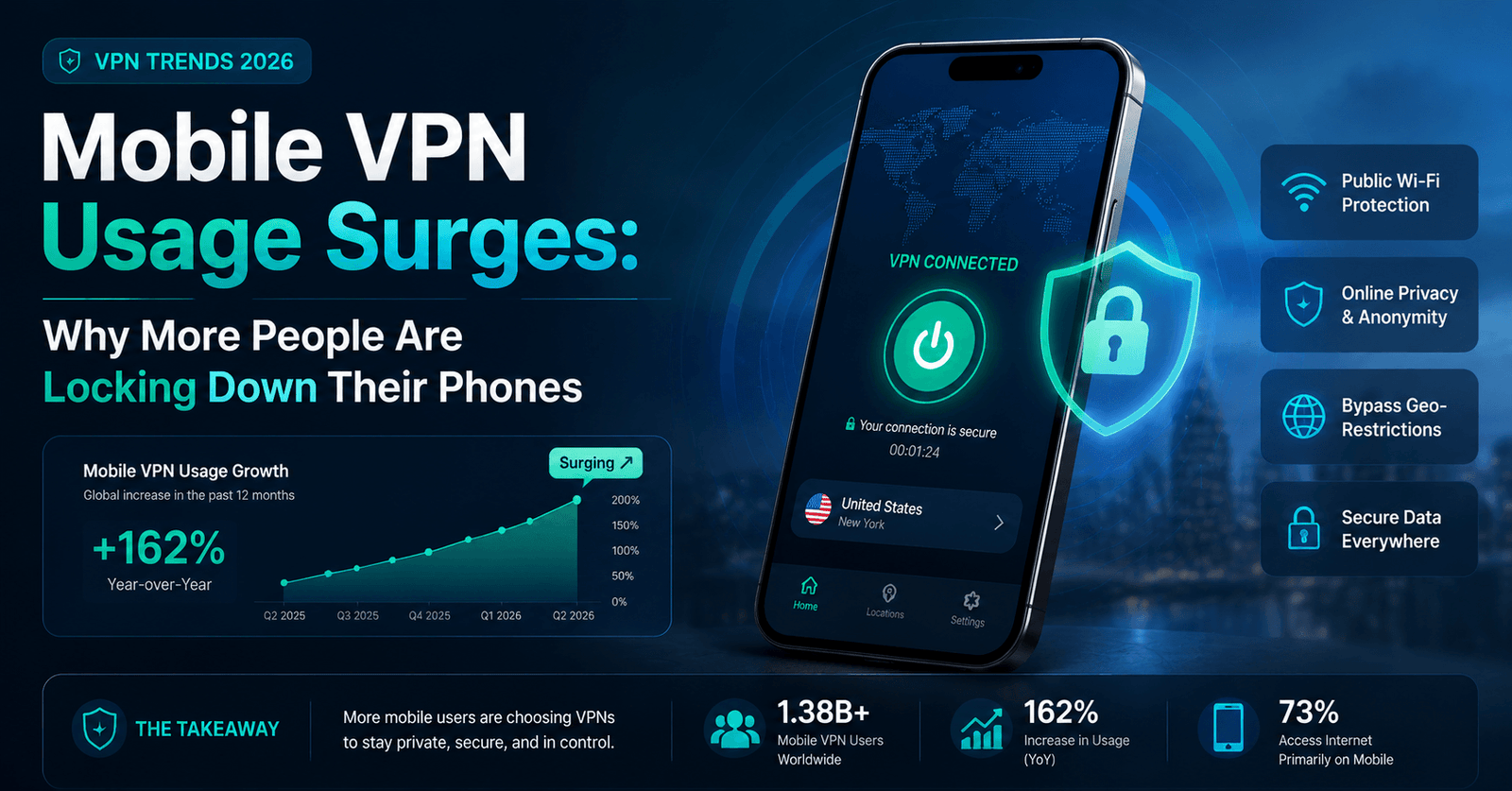
VPN usage has traditionally been thought of as a desktop habit — something people set up on a laptop for work or for streaming, then largely ignore on their phone. That pattern has been changing steadily, and mobile devices are now where a growing share of VPN activity actually happens. The reasons behind this shift say as much about how people use their phones today as they do about VPN technology itself.
The Numbers Behind the Trend
Phones have quietly become the primary computing device for a huge share of daily internet activity: banking, messaging, shopping, navigation, and social media are now overwhelmingly mobile-first behaviors for most people. As that shift happened, the amount of sensitive personal data flowing through a phone’s network connection grew right along with it, and users have gradually started treating their phone’s security posture with the same seriousness they once reserved for a work laptop. VPN providers have responded by putting real engineering effort into their mobile apps rather than treating them as a stripped-down afterthought to the desktop client, which has in turn made mobile VPN use more practical and less frustrating than it used to be.
Public Wi-Fi Risks Haven’t Gone Away
Coffee shops, airports, hotels, and transit systems remain full of open or lightly secured Wi-Fi networks, and the basic risks of connecting to them are unchanged: a malicious actor on the same network can, under the right conditions, intercept unencrypted traffic or set up a lookalike network designed to capture credentials. What has changed is awareness. A wider swath of the public now understands, even at a basic level, that public Wi-Fi is not equivalent to a home network, and a VPN remains one of the simplest tools available to reduce that specific risk by encrypting traffic between the device and the VPN server regardless of how trustworthy the local network is.
App Tracking and Data Brokers Are a Growing Concern
Beyond the classic public Wi-Fi scenario, a large part of the recent surge in mobile VPN interest is tied to a broader unease about app-level tracking. Mobile operating systems have added privacy controls over the years, but plenty of apps still collect and share substantial amounts of behavioral and location data with advertising and data broker networks. A VPN does not stop an app from collecting data the user directly provides to it, but it can mask the underlying IP address and network-level location that would otherwise be visible to any service the device connects to, which is one reason privacy-conscious users increasingly treat a VPN as one layer in a broader personal privacy strategy rather than a complete solution on its own.
Addressing Battery and Performance Myths
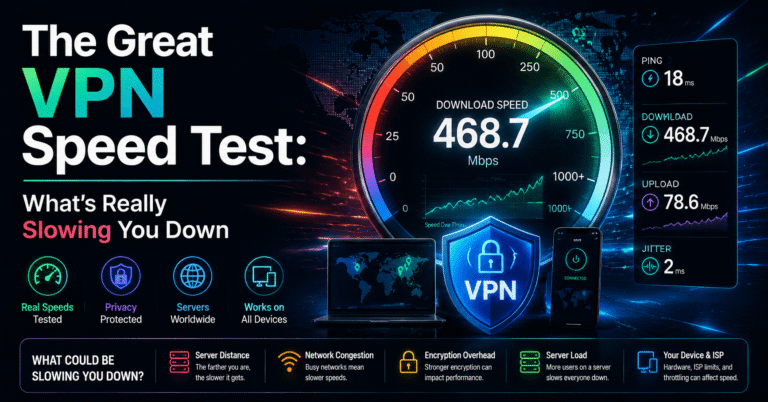
A long-standing objection to mobile VPN use has been the assumption that it drains battery life or noticeably slows down a connection. Modern VPN protocols designed with mobile efficiency in mind have narrowed this gap considerably compared to older, heavier protocols, and for most everyday browsing and messaging use, the difference is small enough that many users no longer notice it. Where it remains most noticeable is in bandwidth-intensive activity like large downloads or video calls on a weak connection, where the additional encryption overhead can compound an already marginal signal. For typical daily use, though, the performance cost has become a much smaller consideration than it was in the past.
Choosing a Mobile VPN That Actually Fits Phone Use
Not every VPN app is built the same way, and mobile-specific features have become a meaningful differentiator. A well-designed mobile VPN app should reconnect automatically and quickly when switching between Wi-Fi and cellular data, since phones move between networks constantly in a way laptops generally do not. It should also include a reliable kill switch that blocks traffic if the VPN connection drops unexpectedly, since a brief gap in protection matters more on a device that is almost always transmitting some form of background data.
Split Tunneling: A Feature Worth Understanding
Split tunneling allows a user to choose which apps route through the VPN and which connect directly, and it has become one of the more useful mobile-specific features precisely because phone usage patterns are so mixed. A user might want their browser and messaging apps protected by the VPN while leaving a banking app or a navigation app on the direct connection, either for compatibility reasons or simply because the added privacy is unnecessary for that particular use case. Providers that offer granular, per-app split tunneling on mobile have generally seen this feature become one of the most used settings in their apps.
Why This Trend Is Likely to Keep Growing
None of the underlying drivers behind mobile VPN growth look like temporary blips. Phones are not becoming less central to daily life, public Wi-Fi is not disappearing from cafes and airports, and concern about app-level tracking has, if anything, been rising rather than fading as more high-profile data-sharing stories reach mainstream attention. Combined with VPN apps that are genuinely easier and more efficient to use than they were a few years ago, the conditions that produced this surge in mobile adoption appear durable rather than a short-lived spike, which is why providers continue to prioritize mobile engineering investment rather than treating it as a secondary platform.
Best Practices for Mobile Privacy Beyond the VPN Itself
- Keep the phone’s operating system and VPN app updated, since security patches matter as much on mobile as on desktop.
- Review app permissions periodically, since a VPN does not limit what data an app collects directly from the device.
- Enable the VPN’s kill switch feature if available, particularly when using public networks regularly.
- Use split tunneling deliberately rather than routing every single app through the VPN by default if performance is a concern.
- Treat a VPN as one part of a broader mobile privacy approach rather than a single fix for every concern.
Travel Has Become a Major Driver
International travel has bounced back significantly, and travelers make up a disproportionate share of new mobile VPN sign-ups. This is driven by a combination of factors: unfamiliar public Wi-Fi networks in airports and hotels, a desire to access home-country banking and streaming services while abroad, and in some cases a need to route around local network restrictions in certain countries. Providers have responded by building travel-specific features directly into their mobile apps, including simplified interfaces for quickly connecting to a “home region” server and clearer indicators showing which server locations are currently performing best, tailored specifically to the more time-pressured, less technical way people tend to use apps while traveling.
Family and Multi-Device Considerations
Mobile VPN adoption has also been shaped by families managing multiple devices under a single subscription. Parents increasingly want the same baseline protection extended to a child’s phone as their own, without requiring a technical setup process for every device added to the household. This has pushed providers to simplify multi-device account management, including shared subscription dashboards that let a single account holder monitor and adjust settings across several phones and tablets at once, rather than requiring each family member to manage their own separate configuration.
The Connection Between Mobile VPNs and Ad and Tracker Blocking
A meaningful share of the recent growth in mobile VPN apps has come bundled with built-in ad and tracker blocking features that operate at the network level rather than requiring a separate browser extension, which does not exist in the same way on mobile browsers as it does on desktop. This bundling has made VPN apps feel more immediately useful to casual users who might not have prioritized privacy on its own, since the visible reduction in intrusive ads and page clutter provides an instantly noticeable benefit alongside the less visible network-level protection. Providers have leaned into this by prominently marketing the combined feature set rather than treating tracker blocking as a minor add-on.
What to Watch For When Comparing Mobile Apps
Beyond the core features already discussed, a few smaller details can meaningfully affect day-to-day satisfaction with a mobile VPN app: how quickly it reconnects after the phone wakes from sleep, whether it respects the operating system’s battery optimization settings without requiring the user to manually exempt it, and how clearly it communicates connection status through the phone’s notification system. These details rarely appear on a feature comparison chart, but they are often what separates an app that people keep enabled at all times from one that gets turned off in frustration after a few weeks.
Conclusion
The rise in mobile VPN usage reflects a fairly rational response to how central phones have become to daily digital life. As the amount of sensitive activity happening on mobile devices has grown, so has the reasonable expectation that those devices deserve the same baseline protections people have long applied to laptops and work computers. With mobile-specific features like efficient protocols, reliable auto-reconnect, and granular split tunneling now widely available, using a VPN on a phone has become considerably more practical than it once was, which likely explains why the trend shows no sign of slowing down.
About the Author