

Forge of Empires Review
Most browser games ask for five minutes of your attention. Forge of Empires asks for years — and somehow, after more than a decade online, it’s still finding new players willing to give it exactly that.
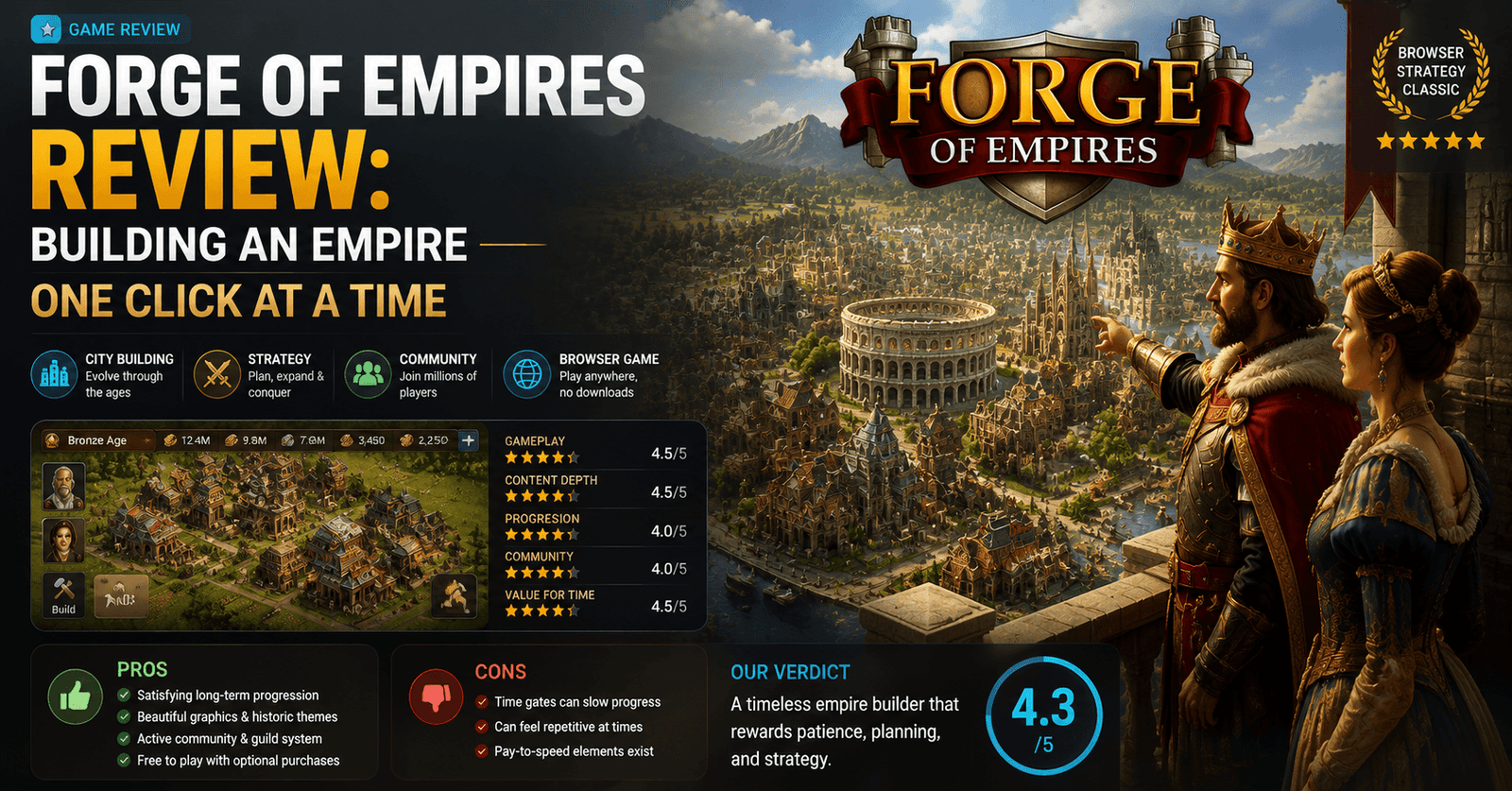
Forge of Empires is a browser-based city-building and strategy game that walks players from the Stone Age through the modern era and beyond, all without ever leaving the tab it opened in. I spent close to three weeks building, researching, and negotiating my way through several eras for this review, and what struck me most wasn’t any single feature — it was how deliberately the whole thing is paced to keep you coming back a little bit every day, for a very long time.
The Premise: History as a Progression System
The core hook of Forge of Empires is deceptively simple: you’re given a small settlement in the Bronze Age and asked to grow it. Houses generate population, production buildings generate coins and goods, and a research tree — visually laid out as a technology tree spanning real historical eras — determines which buildings, units, and city upgrades become available next. As you research your way forward, your city visually transforms: thatched huts give way to stone keeps, then to Renaissance townhouses, then to steam-powered factories, and eventually to buildings that look like they belong in a near-future skyline.
It’s a clever structural trick. Rather than a generic “level up” system, your progress is framed as advancing through human history, and the game leans into this with era-appropriate music, art direction, and unit design. Culturally, it gives the grind a narrative shape that a lot of city-builders lack — you’re not just watching numbers go up, you’re watching your city move through the Iron Age into the Colonial era into the Industrial Revolution.
“It’s less a game you play in one sitting and more a garden you check in on — water it a little, and it keeps growing.”
City Building: Puzzle-Box Efficiency
Where Forge of Empires separates itself from typical city-builders is in how tightly space is rationed. Your city plot is a fixed grid, and every building — from a humble cottage to a sprawling factory — has a specific footprint that eats into that limited space. This turns city planning into an ongoing optimization puzzle: do you keep the small, low-yield houses from three eras ago, or bulldoze them for higher-density housing that costs more upkeep but frees up room for cultural buildings that boost happiness?
This scarcity is the game’s smartest design decision. It means there’s rarely a single “correct” city layout, and min-maxers can spend real time theorycrafting optimal builds while casual players can just build what looks good and still make reasonable progress. Road placement matters too — buildings disconnected from your road network lose efficiency, which adds another light layer of logistics to think through as your city grows.
| Category | Score |
|---|---|
| City Building Depth | 9 / 10 |
| Combat & Strategy | 7 / 10 |
| Social & Guild Features | 8 / 10 |
| Long-Term Engagement | 8.5 / 10 |
| Monetization Pressure | 6.5 / 10 |
Combat, Diplomacy, and the Continent Map
Beyond your home city, Forge of Empires layers in a turn-based tactical combat system used to conquer sectors of a broader continent map. Battles are fought on a hex grid with unit-type advantages that roughly mirror rock-paper-scissors logic — ranged units counter melee, melee counters light cavalry, and artillery devastates entrenched positions but struggles in the open. It’s not a deep tactics game by the standards of dedicated strategy titles, but it’s a satisfying enough diversion, and importantly, every fight can be auto-resolved or fully diplomatic-negotiated instead, so combat-averse players aren’t locked out of expansion.
The Guild system is where the social layer really lives. Joining a guild opens up Guild Expeditions (co-op PvE content with escalating difficulty) and Guild vs. Guild battlegrounds for players who want competitive stakes. Coordinating with a guild noticeably accelerates progress through shared bonuses and pooled resources, and it’s clear the developers have spent years tuning this layer — it feels less like an afterthought and more like a second game running in parallel with the city-building core.
The Free-to-Play Balance
This is where Forge of Empires asks for the most scrutiny. The game is free to play and genuinely playable without spending, but the premium currency (diamonds) touches almost every system — speeding up construction, buying premium buildings with better output-to-space ratios, and unlocking cosmetic city decorations that also happen to provide gameplay bonuses. None of this is pay-to-win in the sense of buying raw military dominance, since combat can largely be avoided through diplomacy, but it is pay-to-accelerate in a way that becomes more noticeable the further into the tech tree you go.
Daily login rewards, event currencies, and quest chains do a reasonable job of drip-feeding diamonds to free players, and community events (seasonal ones tied to real-world holidays, plus recurring ones like the Guild Expedition) provide steady goals without requiring a subscription. Patient players who don’t mind slower growth can absolutely reach the late eras without spending, but the game is candid about the fact that money buys convenience.
Visuals, UI, and Browser Performance
Visually, Forge of Empires has aged remarkably well for a browser title with over a decade of history. The isometric art style holds up, era transitions are handled with genuine care, and the UI — while dense, given how many systems it’s tracking — is organized logically enough that new players won’t feel completely lost after the tutorial. Load times are quick, and the game runs smoothly in-browser with no noticeable memory creep even after extended sessions, which isn’t something every long-running browser title can claim.
A companion mobile app exists and syncs with the browser version, letting you check on production queues and collect resources on the go — a genuinely useful bit of quality-of-life for a game built around frequent, short check-ins rather than long unbroken sessions.
How It Compares to Other Browser Strategy Games
Forge of Empires sits in a crowded genre alongside titles like Tribal Wars and various browser-based 4X strategy games, but it distinguishes itself by leaning harder into single-player-friendly pacing than most of its competitors. Many browser strategy titles are built around near-constant player conflict, where leaving your city undefended for a day can mean losing resources or territory to a rival. Forge of Empires deliberately softens this: the negotiation system means diplomatic solutions are always on the table, and the PvP tower defense mechanic that protects your home city is generous enough that casual players rarely feel like they’re one bad login away from disaster.
This makes it a notably better fit for players who want strategic depth without the anxiety of an always-online conflict simulator. The trade-off is that players specifically looking for cutthroat, high-stakes PvP will likely find the combat here too optional and too softly punished to scratch that itch — Forge of Empires is a builder first and a war game a distant second, and it’s honest about that priority in how its systems are weighted.
Community, Support, and Long-Term Stability
Longevity is arguably Forge of Empires’ single strongest selling point. A browser game surviving well over a decade in a market where most titles in the genre fold within a couple of years is not a small thing, and it reflects a level of ongoing developer investment that’s rare to find. Regular events tied to real-world seasons and holidays keep the content calendar full without feeling like filler, and the developers have continued adding entirely new eras well past the original scope of the game, giving veteran players genuine reasons to keep researching forward rather than hitting an endgame wall.
The player community reflects that stability. Guild recruitment channels stay active, in-game forums see regular developer responses to balance feedback, and the game’s wiki-style community resources are unusually thorough — a byproduct of a playerbase that has had over ten years to document strategies, building efficiency ratios, and optimal city layouts. For new players, this means a wealth of external guidance is available if the in-game tutorial leaves any systems feeling unclear, which, given the sheer number of interlocking mechanics, it occasionally does.
Pros and Cons
What Works
|
What Doesn’t
|
Final Verdict
Forge of Empires isn’t a game you binge over a weekend — it’s a game you fold into your routine, checking production queues over morning coffee and planning your next city expansion during a coffee break. That slow-burn design won’t appeal to everyone, and the premium currency’s reach into nearly every system means free players will feel the pace difference eventually. But for anyone who enjoys optimization puzzles wrapped in a genuinely well-realized march through human history, it remains one of the most well-built browser strategy games available, over a decade after launch.
Topody Score: 7.9 / 10 — A patient, deeply systemic city-builder that rewards long-term commitment more than quick sessions.
About the Author