


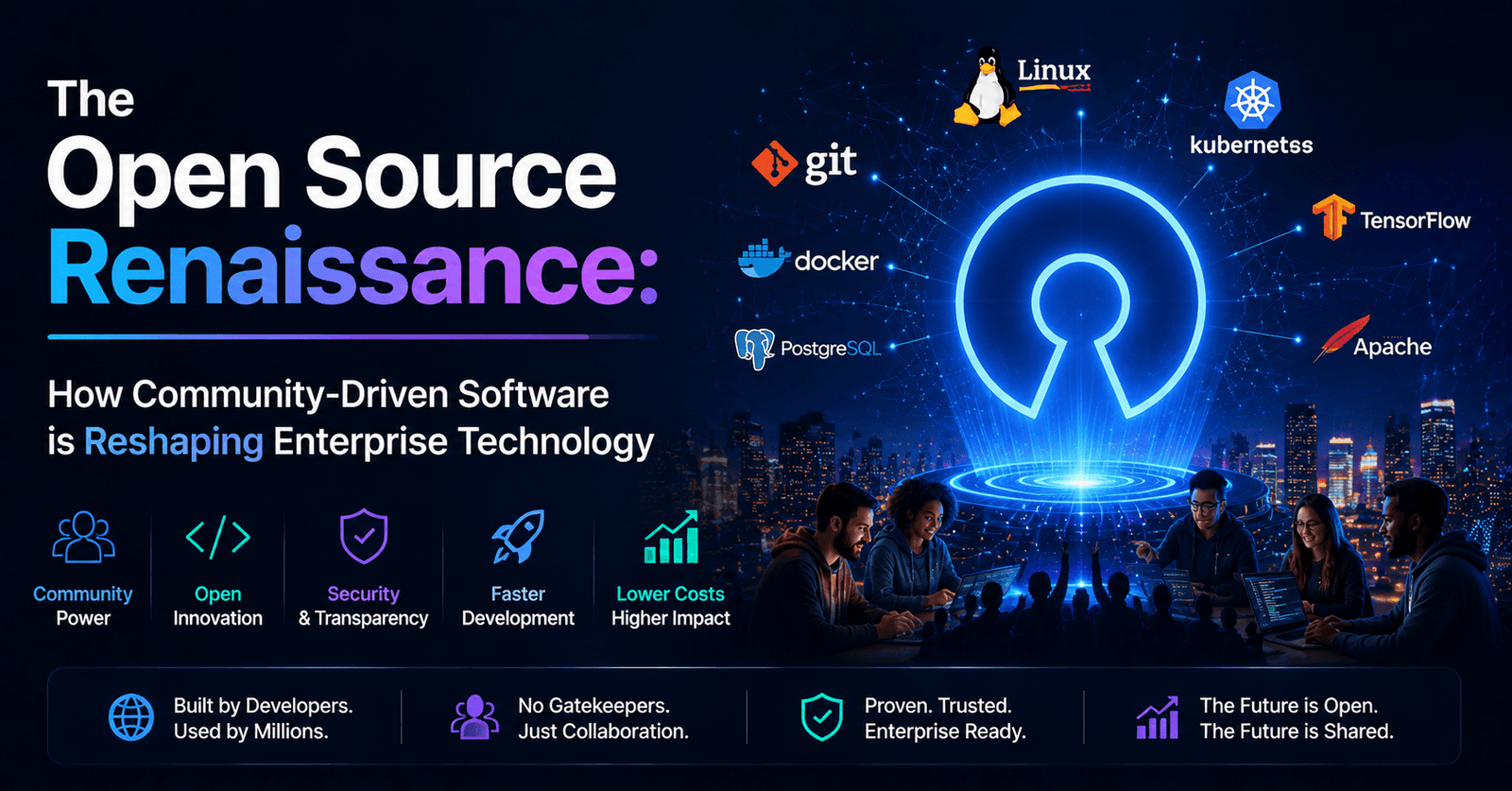
The Open Source Renaissance: How Community-Driven Software is Reshaping Enterprise Technology
We are currently witnessing a remarkable and multifaceted resurgence in open source software that is fundamentally altering the relationship between enterprise technology strategy and community-driven development. What began as a countercultural movement in the late 1990s, was subsequently commercialized through various business models in the 2000s and 2010s, faced existential questions about long-term sustainability in the early 2020s, and has now emerged in 2026 as a mature, economically sustainable, and increasingly dominant force in the global technology landscape. This open source renaissance is not merely a continuation of previous trends or a cyclical return to earlier values—it represents a qualitative shift in how software is created, governed, monetized, and integrated into the strategic fabric of modern enterprises.
The Sustainability Revolution: Solving Open Source’s Existential Crisis
For many years, the open source community grappled with a fundamental and increasingly urgent paradox: the world’s most critical software infrastructure—from operating system kernels to encryption libraries to web servers—was maintained by unpaid volunteers, underfunded individual maintainers, or small teams working in their spare time, while trillion-dollar corporations built enormously profitable businesses on top of this freely available foundation. The “tragedy of the commons” in software manifested concretely as maintainer burnout, security vulnerabilities in neglected dependencies, abandoned projects, and high-profile incidents like the Log4j crisis that exposed the terrifying fragility of this unsustainable model.
The year 2026 marks a genuine turning point in this narrative. A new generation of funding mechanisms, governance models, and commercial frameworks has emerged to ensure open source sustainability without compromising the transparency, collaboration, and freedom that make open source powerful and valuable.
GitHub Sponsors, Open Collective, Tidelift, and similar platforms have matured into robust and reliable funding ecosystems that connect corporate beneficiaries directly with individual maintainers and project teams. But more significantly and structurally, we are seeing the rise of “open source cooperatives”—innovative legal structures where contributors collectively own and democratically govern projects, sharing in the commercial value they create through equitable compensation models. The Open Source Pledge initiative, where companies commit to paying maintainers based on their actual dependency usage and derived value, has gained substantial traction among responsible corporate citizens who recognize that their business continuity depends on healthy upstream projects.
The results of these sustainability efforts are tangible and measurable. Core maintainers of critical infrastructure projects are increasingly able to work on open source full-time, funded by diverse combinations of corporate sponsorships, community contributions, grant funding, and innovative monetization strategies. The median income for active maintainers of popular and widely-depended-upon projects has increased by over 300% during the past two years, transforming open source contribution from a labor of love or resume-building activity into a genuinely viable, respected, and financially rewarding career path.
Open Source as Competitive Strategy: The Enterprise Mindset Shift
Perhaps the most surprising and consequential development in 2026 is how enterprise attitudes toward open source have fundamentally evolved from grudging acceptance to enthusiastic strategic embrace. Where companies once viewed open source primarily as a cost-saving measure, a marketing tool, or a necessary evil, they now increasingly recognize it as a fundamental competitive strategy and essential component of their technology portfolio.
Major technology companies are open-sourcing not just peripheral utilities and developer tools but core competitive technologies that were previously closely guarded intellectual property. Meta’s continued and substantial investment in openly available AI models, Google’s strategic open-sourcing of key infrastructure components, Microsoft’s transformation into one of the world’s largest open source contributors, and even traditionally proprietary companies like Apple making significant contributions to open source foundations all signal a profound and irreversible shift in strategic thinking at the highest corporate levels.
The underlying business logic is compelling and increasingly well-understood. In a world where software differentiation increasingly comes from proprietary data, unique user experiences, vertical integration, and network effects, the underlying infrastructure has become commoditized. By open-sourcing foundational infrastructure, companies can shape industry standards in their favor, reduce their own maintenance burden through community contributions, attract and retain top engineering talent that wants to work on visible, impactful, and publicly recognized projects, and build ecosystems that reinforce their market position.
Moreover, open source has proven to be a remarkably powerful distribution channel and customer acquisition mechanism. Projects that gain authentic community traction organically attract users, contributors, and eventually enterprise customers who need professional support, additional features, and guaranteed service levels. The “open core” business model—where the base software is fully open source and premium enterprise features, managed services, or advanced capabilities are commercially licensed—has proven remarkably effective and sustainable for companies like GitLab, MongoDB, Elastic, HashiCorp, and Confluent.
The Rise of Open Source AI: Democratizing Intelligence
No discussion of the 2026 open source landscape would be complete or accurate without addressing the revolutionary impact of artificial intelligence. The open source AI movement has become one of the most significant and disruptive forces in technology, directly challenging the dominance of proprietary models from OpenAI, Google, Anthropic, and other closed providers.
Meta’s Llama family of large language models, Mistral AI’s increasingly capable offerings, Alibaba’s Qwen models, and the burgeoning ecosystem of community fine-tuned variants have genuinely democratized access to large language models and other generative AI capabilities. These open models are not merely research curiosities or academic benchmarks—they are being deployed in production environments by enterprises that value transparency, customizability, freedom from vendor lock-in, and the ability to run models on their own infrastructure with their own data.
The open source AI ecosystem extends far beyond foundation models to include comprehensive training frameworks like PyTorch and JAX, massive curated datasets, rigorous evaluation benchmarks, efficient deployment tools, and optimization libraries. Projects like Hugging Face’s Transformers ecosystem, LangChain for application development, Ollama for local deployment, and vLLM for efficient inference serving have created a complete, integrated stack for building sophisticated AI applications without relying on proprietary APIs or sending sensitive data to third-party services.
This democratization has profound implications for software development, business strategy, and competitive dynamics. Developers can now fine-tune open source models on proprietary domain-specific data, deploy them entirely on their own infrastructure, modify architectures to meet specific requirements, and avoid the unpredictable pricing, usage limits, and data privacy concerns associated with proprietary AI APIs. The “black box” problem of proprietary AI is replaced with transparent, auditable, and customizable systems that enterprises can confidently trust with their most sensitive data and critical business processes.
Governance Evolution and the New Social Contract
As open source projects have grown in economic importance, technical complexity, and societal impact, governance has become a critical concern that can no longer be addressed informally. The traditional model of a single benevolent dictator for life served smaller projects well but has proven inadequate for infrastructure that underpins significant portions of the global digital economy.
2026 has seen the widespread adoption and refinement of more sophisticated, transparent, and accountable governance models. Foundation-based governance, where projects are hosted by neutral nonprofit organizations like the Linux Foundation, Apache Software Foundation, Cloud Native Computing Foundation, and the newly formed Open Infrastructure Foundation, provides legal protection, funding stability, vendor neutrality, and transparent decision-making processes that give enterprise adopters confidence.
Technical governance has also evolved substantially. Many major projects now employ explicit meritocratic governance with clearly documented contribution pathways, elected technical steering committees with term limits, transparent decision-making processes, and formal conflict resolution mechanisms. This professionalization of open source governance has made enterprise adoption more palatable to risk-averse organizations and has attracted institutional funding that supports long-term project health.
The “social contract” between open source projects and their users is being actively rewritten through community discussion and explicit documentation. Users increasingly understand that using open source software comes with meaningful responsibilities: contributing back through code, documentation, testing, or funding; reporting security issues responsibly through coordinated disclosure; respecting maintainer time and boundaries; and participating constructively in community discussions. Companies are establishing formal open source program offices (OSPOs) to manage their relationships with the open source ecosystem strategically rather than opportunistically.
Security Transformation: From Weakness to Strength
The security landscape for open source software has undergone a dramatic and largely positive transformation. The high-profile supply chain attacks of the early 2020s—the SolarWinds compromise, the Log4j vulnerability, the xz utils backdoor attempt—served as devastating wake-up calls for the entire technology industry. The response has been a comprehensive and coordinated overhaul of open source security practices, tooling, and cultural norms.
Automated vulnerability scanning integrated into CI/CD pipelines, mandatory Software Bill of Materials (SBOM) generation for all releases, cryptographically signed attestations and provenance records, and reproducible builds have become standard practices across major projects. The OpenSSF (Open Source Security Foundation) has matured into a critical industry body, providing security scorecards, best practice guides, funding for independent security audits of critical projects, and the Sigstore project for artifact signing and verification.
The principle of “security through obscurity” has been thoroughly and permanently discredited. The transparency of open source code, combined with modern security tooling, automated fuzzing, bug bounty programs, and the scrutiny of thousands of potential reviewers, often makes well-maintained open source software more secure than proprietary alternatives where vulnerabilities may remain undiscovered for years. When security issues are discovered in open source projects, the entire global community can contribute to understanding, fixing, and deploying patches, and those patches can be deployed rapidly across the entire ecosystem.
The Developer Experience Renaissance
Open source in 2026 is not merely about source code availability—it is about community health, documentation quality, contributor experience, and inclusive culture. The most successful and sustainable open source projects have invested heavily in making contribution accessible to newcomers from diverse backgrounds, maintaining comprehensive and up-to-date documentation, providing responsive and respectful mentorship, and fostering genuinely inclusive communities.
Development environment tools like GitHub Codespaces, Gitpod, and Dev Containers have largely eliminated the “works on my machine” problem by providing standardized, reproducible development environments that work identically for every contributor regardless of their local operating system or configuration. Automated testing, continuous integration, and deployment pipelines have become so sophisticated and reliable that contributing to major open source projects is often technically easier than navigating internal development environments at large corporations with legacy tooling.
This focus on developer and contributor experience has created a powerful virtuous cycle: better tooling and documentation attract more diverse contributors, more contributors improve the software faster and from more perspectives, better software attracts more users and organizational adopters, and more users provide the resources and motivation to invest in even better tooling and community support.
The Road Ahead: A Mature and Sustainable Ecosystem
The open source renaissance of 2026 is built on a solid foundation of economic sustainability, demonstrable strategic value, and genuine community health. It represents the maturation of a movement that has proven its ability to create software that is not just technically superior but also economically viable, socially responsible, and strategically essential.
For enterprises, the strategic message is clear and urgent: open source is no longer an alternative to commercial software—it is the default and dominant model for infrastructure, a critical component of competitive technology strategy, and an essential element of the modern software stack. Companies that fail to engage strategically with the open source ecosystem risk being out-innovated by competitors who leverage community-driven development effectively.
For individual developers, the open source renaissance offers unprecedented opportunities to build meaningful and financially sustainable careers, work on globally impactful projects, develop deep technical expertise, and shape the future of technology in collaboration with diverse communities worldwide. The barriers to meaningful contribution have never been lower, and the potential impact of individual contributions has never been higher.
This renaissance is not a nostalgic return to the past—it is a bold leap into a future where the collective intelligence of the global developer community, properly supported through sustainable funding, transparent governance, and healthy community practices, creates software that no single organization could build alone. The open source movement has grown up, and the entire technology industry is better for it.
About the Author