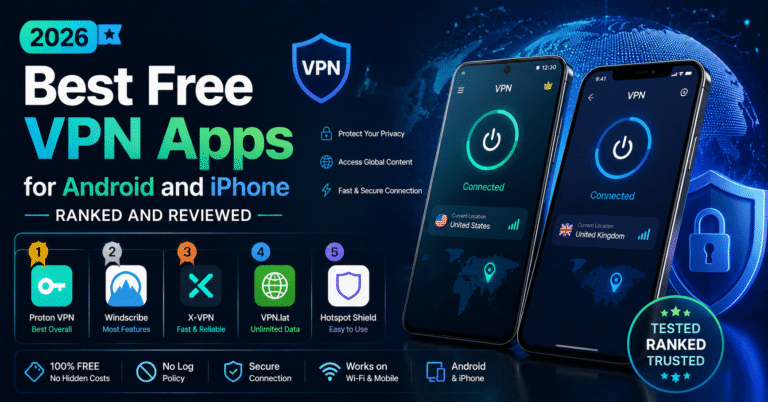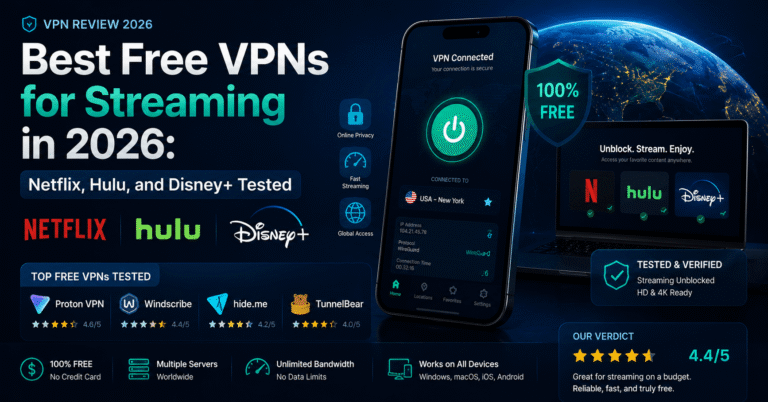


Finding a genuinely trustworthy free VPN in 2026 is harder than it sounds. Search for “free VPN” and you will be met with hundreds of apps promising unlimited speed, unlimited privacy, and unlimited servers — all for nothing. Most of that is noise. A small handful of providers, however, have built free tiers that are fast enough for daily use, transparent about their limits, and backed by privacy policies that actually hold up to scrutiny.
The Homizel Team spent several weeks running speed tests, checking for IP and DNS leaks, reading privacy policies line by line, and using each app the way a real person would — for browsing, video calls, and the occasional stream. Below is our current ranking of the free VPNs worth your time in 2026, along with the ones you should quietly close the tab on.
How We Evaluate Free VPNs
Before ranking anything, we run every provider through the same checklist:
- Logging policy — does the provider collect connection logs, activity logs, or neither, and has that claim ever been independently verified?
- Data allowance — is there a hard monthly cap, a daily cap, or genuinely unlimited data?
- Encryption and protocols — is the app using modern protocols like WireGuard or OpenVPN with AES-256, or something outdated?
- Leak protection — does the app include a kill switch, and does it actually stop traffic if the tunnel drops?
- Real-world speed — how much throughput is lost compared to a direct connection?
- Business model — how does the company make money if the product is free? This single question eliminates more apps than any other filter.
Homizel Quick Take: If a free VPN cannot clearly explain how it pays its server bills, assume the answer is “by monetizing you” and move on.
Quick Comparison Table
| VPN | Data Cap | Server Locations | Streaming | Best For |
|---|---|---|---|---|
| Proton VPN Free | Unlimited | ~5 countries | Limited | Everyday privacy |
| PrivadoVPN Free | 10 GB/month | ~12 countries | Good | Occasional streaming |
| Windscribe Free | 10 GB/month | ~10 countries | Moderate | Power users |
| hide.me Free | 10 GB/month | ~5 countries | Limited | Advanced settings |
| TunnelBear Free | 2 GB/month | ~40+ countries | Poor | First-time VPN users |
How Free Tiers Actually Make Money
It is worth pausing on why any of these companies bother offering a free product at all. In every case on this list, the free tier functions as a funnel toward a paid subscription: it lets a curious user experience real server infrastructure, real encryption, and a real app before deciding whether to pay for more data, more locations, or more devices. That is a fundamentally different model from an app that has no visible paid tier at all, which usually means the free version itself is the entire product — and the actual customers are advertisers or data buyers, not you. Every provider reviewed below has a public, paid product sitting alongside its free plan, which is one of the clearest signs its free tier is a legitimate loss-leader rather than a data-harvesting operation.
1. Proton VPN Free — Best Overall for Unlimited Privacy
Proton VPN’s free tier remains the only one on this list you can leave switched on around the clock without worrying about a data ceiling. The company is Swiss-based, open-source on the client side, and has put its no-logs claims through independent audits. That combination of transparency and unlimited usage is rare in the free VPN space.
The trade-off is choice: the free app automatically connects you to the fastest available free server rather than letting you pick a country, and the free server list is limited to a handful of locations. That makes it a poor fit if you need to appear in a specific country for streaming, but an excellent fit if your goal is simply encrypting your traffic on public Wi-Fi, at the airport, or on a hotel network.
Pros: unlimited data, audited privacy practices, open-source apps, no ads, unlimited connection time.
Cons: no manual server selection, only a handful of free locations, no streaming or torrenting support on the free tier.
2. PrivadoVPN Free — Best for Streaming and Speed
PrivadoVPN gives free users 10 GB of full-speed data every month, along with access to a genuinely wider spread of server locations than most competitors offer for free. In our testing it was the most reliable option for occasional streaming and light torrenting, at least until the monthly allowance runs out, after which speeds are throttled significantly.
It also bundles a basic ad and malware blocker into the free tier, which is a nice touch. The apps themselves are fairly no-frills, and PrivadoVPN’s no-logs policy has not yet been through a full independent audit, so treat it as “good,” not “gold standard.”
Pros: wider server selection than most free rivals, full-speed data until the cap, built-in ad and malware blocking.
Cons: no independent audit yet, speeds drop sharply once the 10 GB cap is reached, basic app design.
3. Windscribe Free — Best Feature Set
Windscribe packs more configuration options into its free tier than any other provider we tested: split tunneling, a firewall-style kill switch, ad blocking, and a browser extension that works independently of the desktop app. Power users who like to tinker will appreciate the depth here.
The downside is a learning curve — the interface throws a lot of toggles at new users — and the same 10 GB monthly cap as PrivadoVPN. Once you are out of data, that’s it until next month, with no throttled fallback.
Pros: split tunneling, standalone browser extension, generous feature set for a free plan, useful firewall-style kill switch.
Cons: steeper learning curve, hard data cutoff once the cap is hit, interface can feel cluttered for beginners.
4. hide.me Free — Best for Advanced Users
hide.me’s free plan is aimed squarely at people who already know what a VPN protocol is. It offers granular protocol selection, solid encryption, and a reasonably generous 10 GB monthly cap, but only a small number of free server locations and no ability to unlock most streaming libraries.
Pros: detailed protocol controls, solid encryption implementation, generous data cap for a free tier.
Cons: very limited server choice, not built with streaming in mind, less approachable for first-time users.
5. TunnelBear Free — Best for Beginners
TunnelBear trades data volume for simplicity and reach. With only 2 GB per month, it is not going to carry a heavy user very far, but its friendly, cartoon-bear interface and enormous list of server countries make it an easy first VPN for someone who has never used one before and just wants to understand what a VPN does before committing to more.
Pros: extremely approachable interface, wide list of server countries, good for short-term or occasional use.
Cons: very small 2 GB monthly allowance, not suited to streaming or heavy browsing, limited configuration options.
Frequently Asked Questions
Can a free VPN fully replace a paid one?
For light, everyday privacy needs — protecting yourself on public Wi-Fi, hiding basic browsing activity from your internet provider — a reputable free VPN can genuinely be enough. It becomes a poor replacement once you need consistent streaming access, torrenting, multiple simultaneous devices, or advanced features like split tunneling and dedicated IPs.
Do free VPNs slow down my internet connection?
Some slowdown is normal with any VPN, free or paid, since your traffic is being encrypted and routed through an additional server. Free tiers tend to feel this more because their servers are shared among a larger pool of users relative to available capacity.
Is it normal for free VPNs to have a data cap?
Yes. A monthly data cap is one of the most common, and most honest, ways a free VPN tier funds itself — it encourages heavier users to upgrade while still offering genuine protection to casual users. A cap is a far better sign than a “free unlimited everything” claim with no clear catch.
What to Avoid: Red Flags in Free VPN Apps
Not every “free VPN” in an app store deserves your trust. Over the course of this research, we flagged several patterns that should make anyone close the install screen immediately:
- Apps that request permissions unrelated to networking, such as contacts or SMS access.
- Providers with no clearly named parent company or headquarters.
- Privacy policies that reserve the right to share “aggregated” or “anonymized” data with unnamed “partners.”
- Apps that inject their own ads into your browser rather than simply displaying ads inside the app itself.
- No published information about which encryption protocol is actually being used.
Final Verdict
For most people, Proton VPN Free is the safest default: unlimited, audited, and backed by a company with a long privacy track record. If streaming or torrenting is the priority and you can live with a monthly cap, PrivadoVPN Free is the stronger pick. Windscribe Free remains the best choice for anyone who wants to fine-tune their setup, while TunnelBear Free is the gentlest on-ramp for total beginners.
Whichever you choose, remember the golden rule of free VPNs: the moment a provider cannot explain its business model in one clear sentence, it is time to look elsewhere.
About the Author