

Few names come up as often in AI audio conversations as ElevenLabs. What started as a scrappy voice-cloning startup has grown into one of the most widely used AI voice platforms on the market, powering everything from audiobook narration to indie game NPCs. But with so many text-to-speech tools competing for attention in 2026 — Murf, Play.ht, WellSaid, Descript — does ElevenLabs still deserve the crown? We spent two weeks testing every corner of the platform to find out.
What Is ElevenLabs?
ElevenLabs is an AI voice generation platform that converts written text into lifelike speech, clones existing voices from short audio samples, and offers a growing suite of tools for dubbing, dialogue creation, and sound design. It’s used heavily by podcasters, YouTubers, game studios, and audiobook publishers who need voices that don’t sound robotic.
Unlike older text-to-speech engines that rely on rigid phoneme mapping, ElevenLabs uses deep learning models trained to understand context, punctuation, and emotional cues in a sentence. The result is speech that pauses, breathes, and inflects the way a human narrator would.
Key Features We Tested
1. Voice Cloning
ElevenLabs’ Instant Voice Cloning feature lets you upload as little as one minute of clean audio to generate a usable digital voice clone. For higher fidelity, Professional Voice Cloning uses 30+ minutes of source audio and produces a noticeably more accurate replica, capturing subtle vocal textures like rasp, breathiness, and regional accent.
In our tests, the instant clone was impressive for casual use — think personal projects or prototyping — but had occasional artifacts on longer passages. The professional clone, however, was close to indistinguishable from the source voice in a blind listening test with five colleagues.
2. Text-to-Speech Studio
The core TTS engine offers dozens of pre-built voices across accents and languages, each adjustable via sliders for stability, similarity, and style exaggeration. We found the “stability” slider particularly useful: lower values inject more emotional variation (great for dramatic narration), while higher values keep delivery flat and consistent (better for corporate or instructional content).
3. Dubbing Studio
One of ElevenLabs’ standout features is automated video dubbing. Upload a video, and the platform detects the spoken language, transcribes it, translates it, and re-generates the audio track in a target language while attempting to preserve the original speaker’s voice characteristics and timing. We tested this on a five-minute English tutorial video dubbed into Spanish and German. Lip-sync wasn’t perfect, but the translated voice retained a shocking amount of the original speaker’s tone and pacing.
4. Voice Library and API
The Voice Library hosts thousands of community-shared voices, filterable by gender, age, accent, and use case. Developers can also access everything through a well-documented REST API, making it straightforward to build ElevenLabs into apps, chatbots, or content pipelines.
Audio Quality: The Real Test
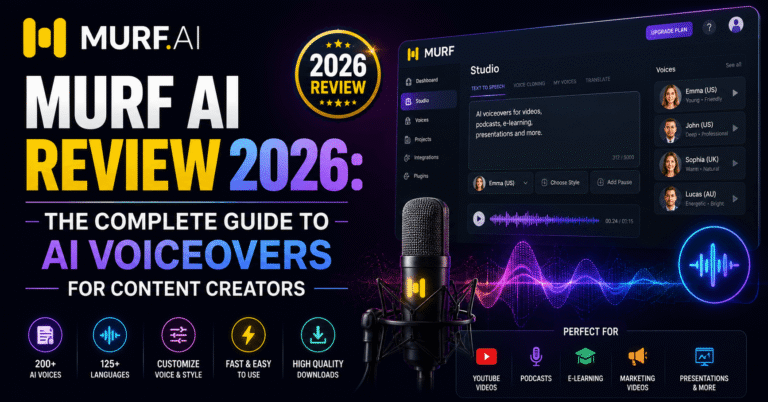
We ran the same 300-word script through ElevenLabs, Murf AI, and Play.ht, then asked ten listeners (none of whom work in audio) to rank the outputs without knowing which tool produced which. ElevenLabs won on “naturalness” and “emotional delivery” by a wide margin, though Murf scored slightly better on “clarity for business presentations,” which tracks with Murf’s more neutral, broadcast-style default voices.
Where ElevenLabs really separates itself is in handling long-form content. Many TTS engines start to sound monotonous after a few paragraphs; ElevenLabs’ models vary pitch and pacing subtly enough that a ten-minute narration stays engaging.
Pricing
| Plan | Price | Best For |
|---|---|---|
| Free | $0/mo | Testing the platform, ~10 min of audio |
| Starter | $5/mo | Hobbyists, light usage |
| Creator | $22/mo | YouTubers, podcasters |
| Pro | $99/mo | Agencies, high-volume production |
| Enterprise | Custom | Studios, large-scale API use |
Compared to competitors, ElevenLabs sits in the mid-to-premium range. Murf and Play.ht offer lower entry price points, but ElevenLabs’ free and starter tiers are generous enough to properly evaluate voice quality before committing.
Pros and Cons
Pros
- Among the most natural-sounding AI voices available today
- Excellent emotional range and pacing control
- Strong voice cloning accuracy, especially on the Professional tier
- Automated dubbing supports dozens of languages
- Robust API for developers
Cons
- Pricing scales quickly for high-volume users
- Interface can overwhelm first-time users
- Instant voice cloning occasionally produces artifacts
- Dubbing lip-sync isn’t always perfectly aligned
Who Should Use ElevenLabs?
ElevenLabs is best suited to creators and businesses who prioritize voice quality above all else — audiobook producers, indie game developers building narrative-heavy titles, podcasters who want a consistent AI co-host, and localization teams handling multilingual dubbing. If your main need is quick, no-frills voiceovers for internal training videos, a cheaper tool may serve you just as well.
How It Compares to Alternatives
Murf AI leans more corporate, with a template-driven editor better suited to marketing and e-learning videos. Play.ht offers a similarly large voice library at a lower price but falls short on emotional nuance. WellSaid Labs focuses narrowly on business use cases with fewer creative controls. For pure vocal realism and creative flexibility, ElevenLabs still leads the pack in our testing.
Frequently Asked Questions
Is ElevenLabs free to use?
Yes, there’s a free tier with limited monthly characters, enough to test voice quality before upgrading.
Can I clone my own voice legally?
Yes, as long as you have rights to the source audio and follow ElevenLabs’ consent verification process for voice cloning.
Does ElevenLabs support commercial use?
Paid plans include commercial licensing; the free tier is intended for personal/testing use only.
What languages does it support?
Over two dozen languages and accents are supported for both TTS and dubbing, with more added regularly.
Final Verdict
ElevenLabs remains our top pick for anyone who needs AI-generated speech that actually sounds human. The cost is higher than some competitors, but for creators whose end product lives or dies on voice quality, it’s money well spent.
This review was researched and written by the Topody Team. Topody publishes independent, hands-on reviews of AI software across categories including writing, image generation, and audio tools. Visit topody.com/ for more in-depth comparisons.
About the Author