


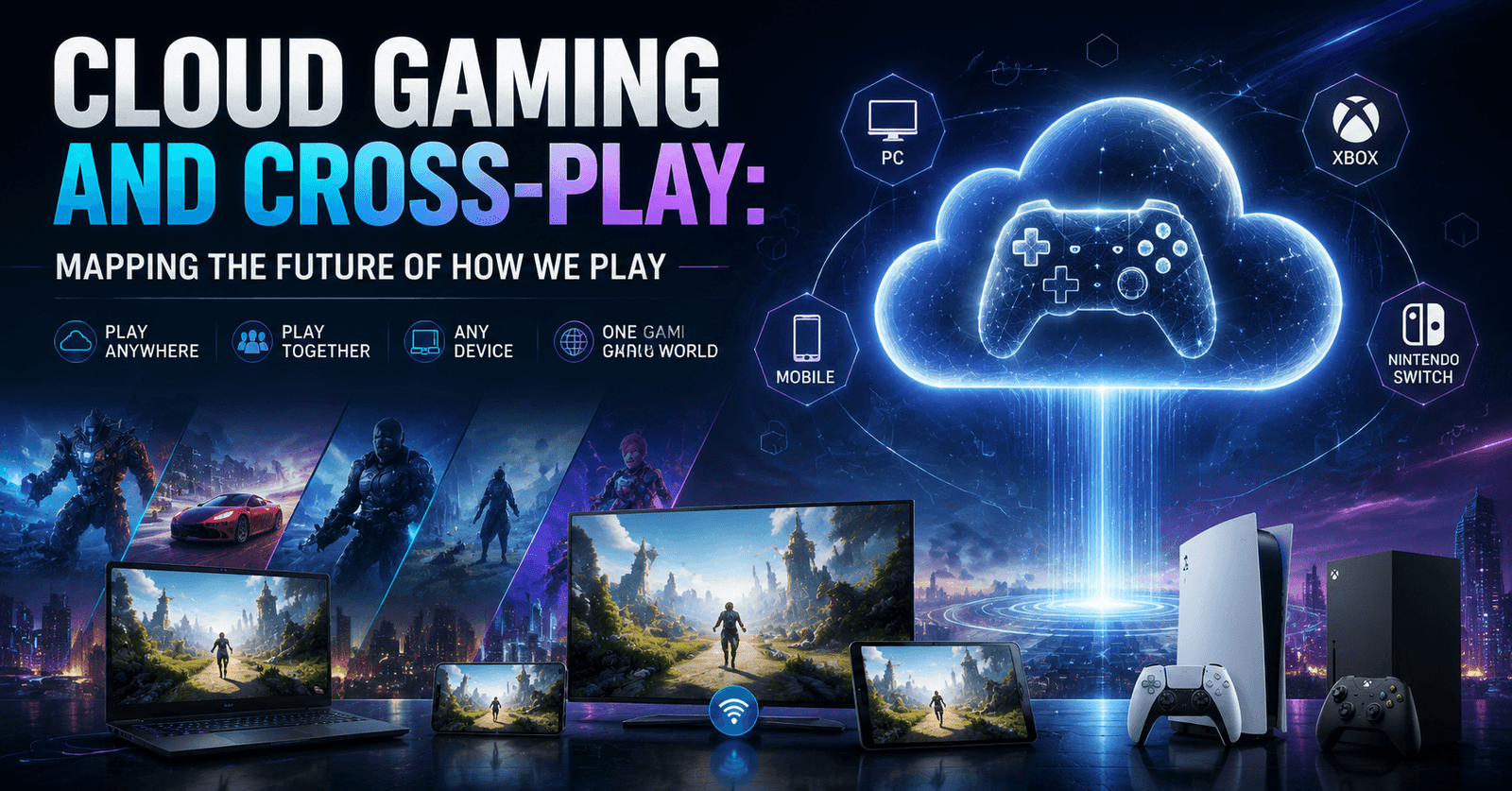
Cloud Gaming and Cross-Play: Mapping the Future of How We Play
For years, cloud gaming was the technology that always seemed to be “just around the corner.” Every few months brought a new headline about a service that would supposedly make dedicated gaming hardware obsolete, followed by lukewarm reviews citing latency issues, patchy library availability, or connectivity requirements that simply were not realistic for most households. That narrative has been shifting. Cloud gaming has not replaced traditional hardware, but it has carved out a genuinely useful role in how people play, and paired with the rise of cross-play, it is reshaping expectations across the industry. Here is where things actually stand.
Cloud Gaming Found Its Lane by Not Trying to Replace Everything
The early marketing pitch for cloud gaming was ambitious to a fault: stream every game, on every device, with performance indistinguishable from local hardware. That promise ran headlong into the physical limitations of networking infrastructure, and the backlash from underwhelmed early adopters was significant. The services that have found sustainable footing since then took a more realistic approach, positioning cloud streaming as a complement to owned hardware rather than a wholesale replacement.
Used this way, cloud gaming genuinely shines in specific scenarios: picking up a demanding game on a work laptop during a lunch break, trying a big new release before committing to a purchase, or continuing a save file on a television at a family member’s house without lugging a console along. These are not headline-grabbing use cases, but they are the kind of everyday convenience that builds durable habits over time.
Network Infrastructure Has Quietly Improved
A meaningful part of cloud gaming’s improved reputation comes down to infrastructure rather than any single dramatic breakthrough. Broadband speeds have crept upward across many regions, mobile data networks have become more capable of handling sustained high-bandwidth streams, and gaming-specific server infrastructure has expanded into more regions, reducing the physical distance data has to travel and therefore cutting down on latency. None of this is glamorous, but cumulatively it has made cloud gaming a viable experience for a much larger share of players than was true just a few years ago.
Subscription Fatigue Is a Real Headwind
Even as the technology has improved, cloud gaming services face a less technical but equally serious challenge: subscription fatigue. Many households are already juggling multiple streaming subscriptions for video and music, and adding yet another recurring charge for gaming is a harder sell than it might have been in an earlier era of more limited subscription options. Services that bundle cloud access with a broader value proposition, such as a library of included games or bundling with existing hardware purchases, tend to see stronger retention than those charging a standalone fee purely for streaming access.
Cross-Play Has Become the Glue Holding a Fragmented Hardware Landscape Together
As gaming hardware options have multiplied, from traditional consoles to gaming PCs to handhelds to cloud streaming devices, cross-play has become the feature that keeps friend groups together despite everyone owning different devices. It is genuinely difficult to overstate how much friction cross-play removes from group gaming. A friend group no longer needs to coordinate a single shared platform to play together; each person can use whatever device suits their preferences and budget.
This has had a noticeable effect on how games are marketed and reviewed. A multiplayer-focused title launching without cross-play support increasingly draws immediate criticism, regardless of how strong the core gameplay is, because it fragments the potential player base right out of the gate and makes it harder for groups of friends to actually play together.
Cross-Progression Is the Next Frontier
Cross-play solved the problem of playing together across devices, but cross-progression, the ability to carry your save data, unlocks, and purchases seamlessly between platforms, remains inconsistent across the industry. Some publishers have embraced this fully, allowing players to start a game on one device and continue on another without losing progress. Others still treat each platform’s progress as siloed, often for reasons tied to differing storefront agreements and revenue-sharing arrangements rather than any technical limitation.
Player pressure on this front continues to build, and it seems likely that cross-progression will follow a similar trajectory to cross-play: an initially inconsistent feature that gradually becomes an expected baseline as more publishers adopt it and players start to notice, and resent, its absence elsewhere.
Handheld Devices Are Cloud Gaming’s Unexpected Ally
The recent wave of gaming handhelds, both dedicated devices and general-purpose Windows-based units, has turned out to be a natural complement to cloud streaming rather than a competitor to it. Many of these devices are powerful for their size but still benefit from offloading the most demanding titles to cloud servers, extending battery life and allowing a single lightweight device to handle a far broader range of games than its onboard hardware could manage alone. This pairing has helped both technologies find a more natural, symbiotic role rather than competing head-to-head for the same use case.
What to Watch Going Forward
The next few years will likely bring continued infrastructure investment aimed at reducing latency further, particularly in regions currently underserved by nearby server locations. Expect more publishers to experiment with hybrid ownership models, where a game purchase includes both a local copy and cloud access, letting players choose whichever method suits their current situation without paying twice. Cross-progression will likely keep expanding, driven largely by player expectation rather than any single technological leap.
Neither cloud gaming nor cross-play is likely to completely eliminate the diversity of hardware people use to play games, and that is probably a good thing. What both technologies are doing instead is making that diversity less of a barrier, letting the game itself matter more than the specific box or screen it happens to be running on.
Topody will continue following these shifts closely, since how we access and play games is turning out to be just as dynamic a story as the games themselves.
About the Author